

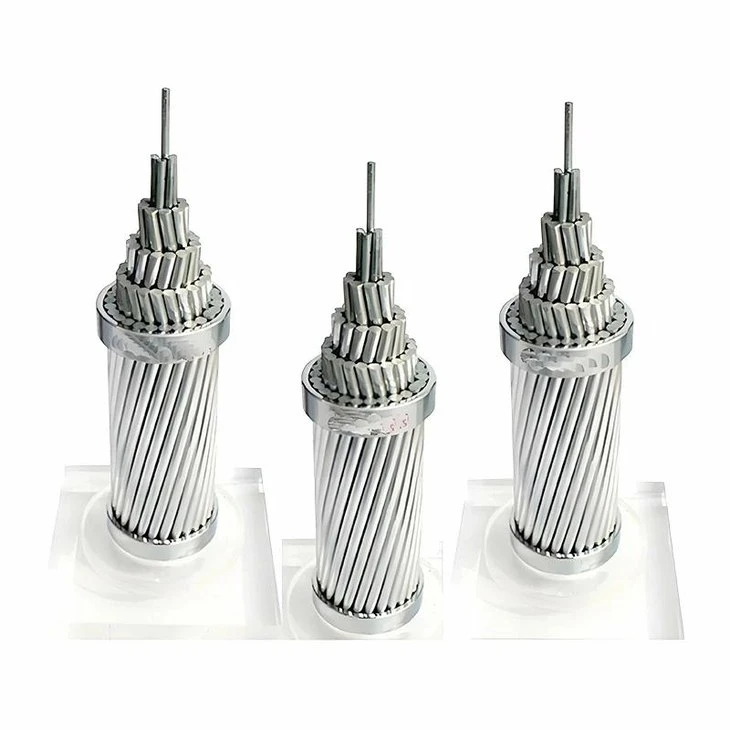
AAC Cable is a bare conductor concentrically stranded from hard-drawn aluminum wires, with a minimum aluminum purity of 99.7%. It is used for overhead transmission and distribution lines.
Products Description
AAC Cable uses electrolytically refined aluminum as raw material, with a 1350-H19 hard-drawn aluminum wire concentric stranding construction. The conductor may be single-layer or multi-layer stranded, depending on ampacity requirements. AAC does not use magnetic reinforcement, so it has no hysteresis loss and lower AC resistance. Aluminum itself has good corrosion resistance, suitable for coastal areas. Due to its relatively low strength-to-weight ratio, AAC is mainly used for short-span urban distribution lines, with limited application in long-span transmission and rural distribution lines.

Product Technical Parameters
|
Item |
Parameter |
|
Conductor material |
1350-H19 hard-drawn aluminum wire |
|
Aluminum purity |
≥99.7% |
|
Stranding |
Concentric lay, single or multi-layer |
|
Standards |
ASTM B230, ASTM B231, BS EN 50182, IEC 61089 |
|
Long-term allowable operating temperature |
70°C |
|
Maximum design temperature |
75°C |
|
Applications |
Low, medium and high voltage overhead lines |
Product Application Scenarios
1.Urban overhead distribution lines with short spans and high conductivity requirements
2.Coastal areas, where aluminum offers good corrosion resistance
3.Railway and metro industries
4.Substation busbars, apparatus connectors and jumpers
5.Overhead lines where conductor strength is not a primary requirement
FAQ
What are the long-term allowable operating temperature and maximum design temperature of AAC Cable?
The long-term allowable operating temperature of AAC conductor is 70°C. In transmission line design, the maximum design temperature should not exceed 75°C. Operating above this temperature accelerates aluminum creep and affects the conductor's mechanical performance and sag control.
What are the requirements for reel placement during transportation and storage of AAC Cable?
Reels should be kept upright, resting on both flanges, not on a single flange, and should not be stacked on top of each other. Wooden wedges are recommended to prevent the reel from rolling during storage. During transportation and storage, avoid impact or compression on the reel.
When is AAC Cable preferred, and when is it not recommended?
AAC is suitable for urban distribution lines with short spans, low mechanical strength requirements, and high conductivity requirements. In long-span transmission lines or rural distribution lines, AAC is not recommended due to its relatively low strength-to-weight ratio; ACSR or AAAC conductors should be selected for such applications.
Hot Tags: aac cable, China aac cable manufacturers, suppliers, factory, acs stranded conductor, corrosion resistant steel core stranded wire, high power fiber optic cable, overhead electrical utility wire, power grid reinforcement strand, transmission cable core strand


